
The Van Halen Test
Can you pass it?

I’ve worked in various roles as a teacher, investor, close quarter combat instructor, consulting interviewer, and private intelligence, all of which are very exacting. In each of these positions I’ve had occasion to use the Van Halen Test. It’s a very simple and valuable test that will tell you a lot about yourself and others. I was put to the test long before I gave it a name, but when I ran across the story in a now long ago lost article, I recognized it immediately.

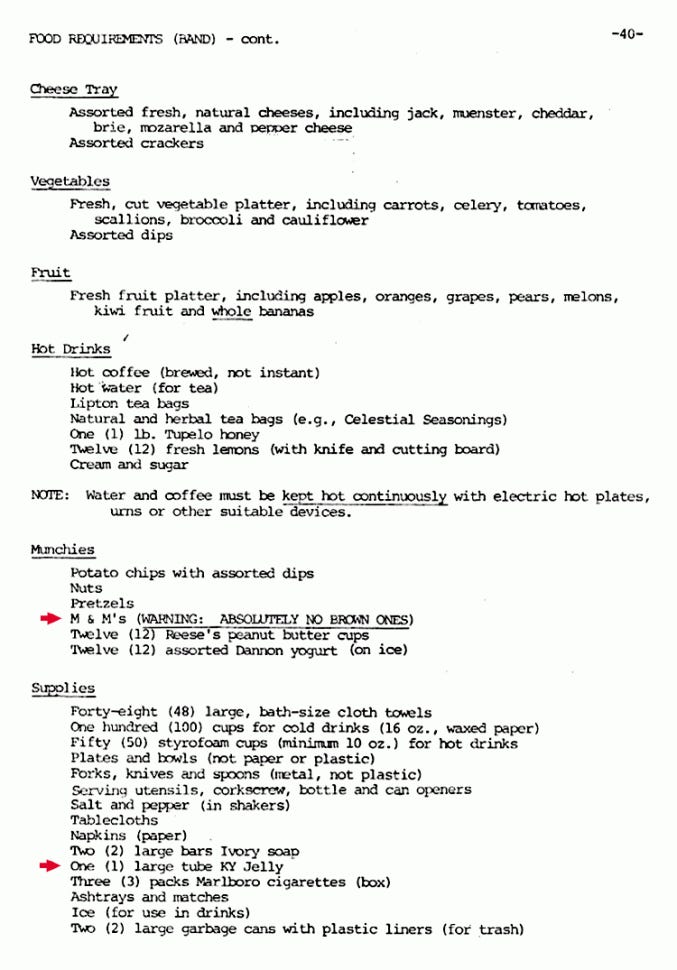
The rock ban Van Halen (Yeah I’m dating myself.) had an apparently idiosyncratic proviso written into their touring contract that at first sounds like the result of the flamboyant lifestyle demands associated with rock bands. The proviso in the contract stipulated that every venue operator on the tour had to provide a large bowl of M&Ms candy that had all the colors…except brown. The brown M&M’s had to be removed. (They also required a tube of KY jelly…) Strange, right? Maybe, but there was a method to the apparent odd requirement. The band would check to see if the bowl of M&Ms was supplied and if the brown M&Ms had been removed. If the band found no bowl of M&Ms or if they had been supplied but the brown M&Ms hadn’t been removed, the band would personally do a line check of the stage set-up. The psychology behind this test was that if the venue operator failed to follow simple instructions required for a bowl of M&Ms, they probably couldn’t be trusted with the safety required in the complex wiring, lighting , and pyrotechnics used by the band in their performance.
My most memorable experience of the Van Halen Test being applied to me was during a CIA interview. I had already has some training in interview and interrogation, so I knew that no good interviewer asks idle questions. Every question has a purpose. Questions are often interrelated and reinforcing to reveal aspects a person that they may not be consciously aware of. My interviewer kept asking me about a fellow grad student who had previously interviewed but was just an acquaintance to me. The interviewers kept cycling back asking me personal question about this fellow’s studies, political views, social interests, etc. I started to get a bit irritated as this was supposed to be my interview. For an introductory interview, you were only slotted for 60 minutes and this guy was burning my time asking about someone else. Then I remembered my interview and interrogation training. The interviewer was Van Halen Testing albeit in a very serious way, that appeared quite innocent. Finally, on the next question about this other student, I looked the interviewer square in the eye and leaned forward across his desk slightly and said, conspiratorially, “Can you keep a secret?” He leaned forward in response with a bit of a grin, “Sure,” he answered. I sat back, and adjusted myself and said, “Good. That makes two of us.” The interviewer gave me a 1000 yard stare for a moment. He made a notation in the file before him. I didn’t know at that time but I had just passed the interviewer’s Van Halen Test. My interview shifted to the next level which was unheard of at the time. I was there for another two hours and left with instructions that I would be getting a phone call from Langley. The interviewer discovered what he wanted. I knew how to keep my mouth shut and keep a confidence; something sort of important in intelligence work.
When I was coaching football I had a Van Halen Test I used for players whose attention wandered. There was a walking track on the far side of the football field about ¼ mile away. “Hey…Run over and get me my rock.” “Huh?” “Did you listen to what I said?” “Oh…yeah Coach…sure.” The player who hadn’t been paying attention in the huddle, wasn’t paying any more attention to my instruction. He’d jog or play around on his way to the running track. Then lollygag on the way back. “Here coach,” handing me a rock. “What’s this?!” “I got you a rock…” “This isn’t MY rock! You didn’t listen. I said run over and get me my rock. You have someone else’s rock. Take it back and put it where you found it.” For the slow listeners it might take 3-4 trips. Then some of his teammates would get frustrated, pull him aside and I’d hear, “LISTEN to coach. He said RUN over and get his rock.” This was followed by one of the fastest sprints of the day with the player dropping a rock in my hand. “Ah…this pleases me…This is my rock.” If they were really slow listeners I’d say, “Now run over and put my rock back where you found it.” Sound mean? If a player can’t focus and listen during practice to small instructions what will he do under game stress when the score is against him and his teammates are depending on him?
In the classroom, early in the year I emphasized listening and following instructions. I had an in class assignment that started out with the instructions to “read all the way to the bottom of the page before doing any of the assignment.” Outlined on the page were some grueling assignments designed to evoke wailing and gnashing of teeth. Hands would shoot up less than half way down the page accompanied with pleas about how unfair and over demanding the outlined assignments were. “Have you followed my instructions?” “Well no, but this is too much work…” At the bottom of the page the last item stated, “Having read this page, sign your name at the bottom and turn it in.” The average number of correct responses was about five out of thirty. A simple form of Van Halen Test, that was somewhat humorous but still got the point across.
As a consulting interviewer I’ll give the interviewee a job application form and ask them to fill it out completely front and back. On the back there are questions about their last 3-4 places of employment. Many people don’t even fill out the back page and I have to return the form to them and repeat my instructions. Even more will scribble “See resume” for the job summaries. Their lack of attention to detail is a red flag I’ll work on during the interview.
Some people say that I’m just being unreasonably picky administering the Van Halen Test. I ask them if they’d be good if the surgeon doing their heart procedure had a 5 second rule for a dropped heart. I point out an old Hospital Conference Board report from Canada: “We all believe no one can be perfect. Ninety-nine percent is good enough, right? What 99 percent accuracy really means is that for 15 minutes every day, your lights and refrigerator, your stove and telephone, would shut down. It means that two passengers on every air flight would reach their destination minus their baggage. And it means that every year, 28 glowing sets of parents would cart the wrong baby home from the hospital.” It may be that many of my pursuits have depended upon people having to make irrevocable decisions based on inadequate and imperfect information under high stress. You may not want to use capital letters and punctuation because, “you’re expressing yourself.” Yeah I heard the same thing 40 years ago. Whatever you think it means to you, it tells others you’re not detailed and dependable. Acing the Van Halen Test is the difference between “thank you for your time” and “expect a call from Langley.” A positive Van Halen Test is the difference between a happy repeat client and a negative online review that costs you an average of 200 potential clients. A positive Van Halen Test could be the difference between someone living and dying.